

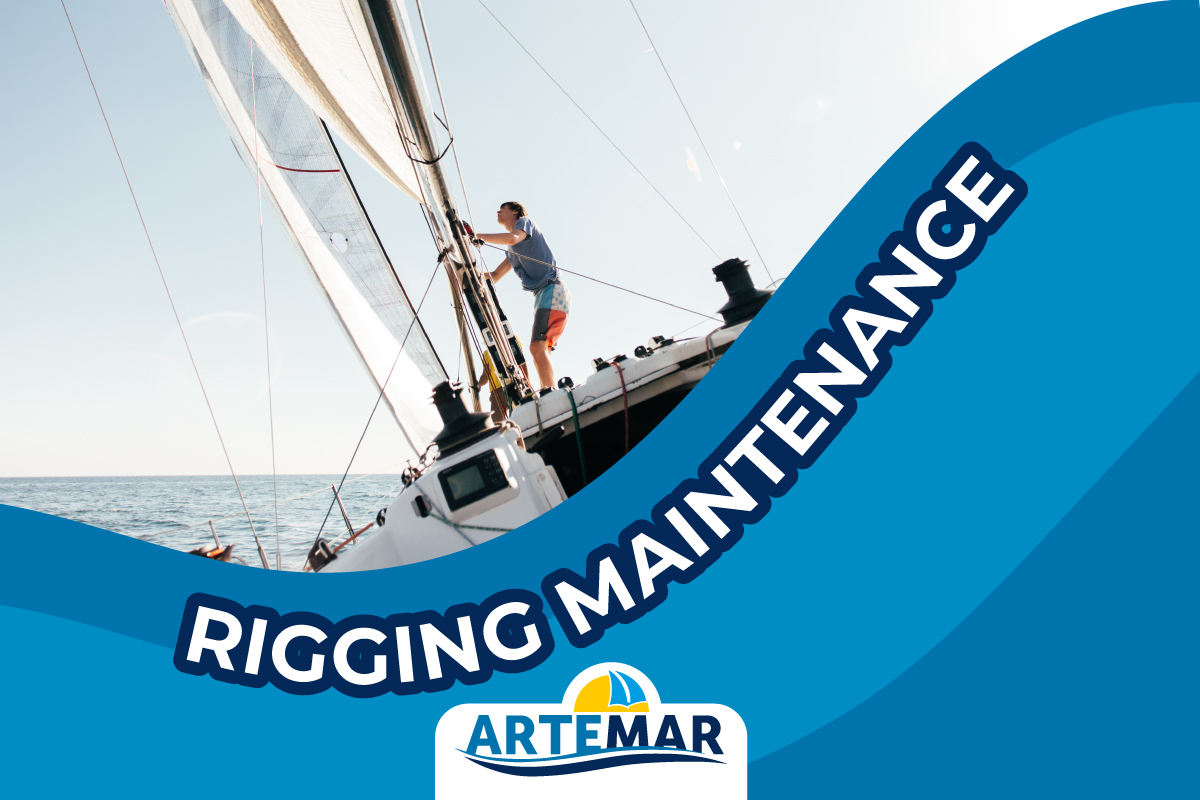
Shrouds and rigging: what truly supports your season
It often happens that you prepare for the season by checking sails, winches and deck, but forget what actually holds everything up: the rigging. As long as the mast stays up, everything seems fine. But rigging works under constant tension and, when it fails, it doesn’t give gradual warnings: it breaks.
It’s not just a matter of performance. It’s a matter of safety.
How a “tired” rigging shows itself
The signs are not always obvious. Sometimes you notice them while sailing: the boat heels more than expected, the mainsail doesn’t work symmetrically, or the mast seems to “breathe” in gusts.
Other times the signs are more subtle: a corroded turnbuckle, worn threads, or slight deformation in the terminals.
The point is, rigging doesn’t fail suddenly without reason. It weakens over time.
And when the season gets underway, with stronger winds and higher loads, every small weakness is amplified.
The most common causes
Rigging is constantly under stress: lateral loads, vibrations, sudden gusts and forces during tacks.
Over time, micro-corrosion can appear in the terminals, wear can develop in the turnbuckle threads, tension can gradually decrease, or small mast misalignments may occur.
Even a slightly unbalanced adjustment can affect the boat’s trim, altering load distribution and sail performance.
And often, you only notice it when sailing in demanding conditions.
What you can check before coming to the yard
A first visual inspection can already tell you a lot.
Check the shroud terminals at the base of the mast, look for signs of corrosion or deformation, and make sure the turnbuckles are not worn or seized.
Look at the mast from bow and stern: is it perfectly aligned? Do the tensions seem even?
If something doesn’t feel right, it’s time for a technical inspection.
The Artemar method: inspection, tuning, safety
During Rigging Maintenance Week, we start with a complete rigging inspection.
We check the structural condition of shrouds and terminals, measure tension levels and analyze mast alignment.
If needed, we carry out targeted adjustments or replace worn components. It’s not about simply “tightening” the rigging, but restoring the mast to a correct and stable balance.
A properly tuned rig is immediately noticeable: the boat responds better, sails perform more efficiently, and navigation becomes more stable and predictable.
Why do it now
April is the right time. Before the season gets busy, you have the time to intervene properly and start with a safe and balanced setup.
Delaying means risking sailing with a stressed system exactly when you need it most.
Want to check your rigging?
If you’re planning your sailing season, now is the right time to check your rigging.
Visit us in Termini Imerese or contact us to schedule your inspection during Rigging Maintenance Week. The safety of your mast isn’t improvised: it’s prepared.
