

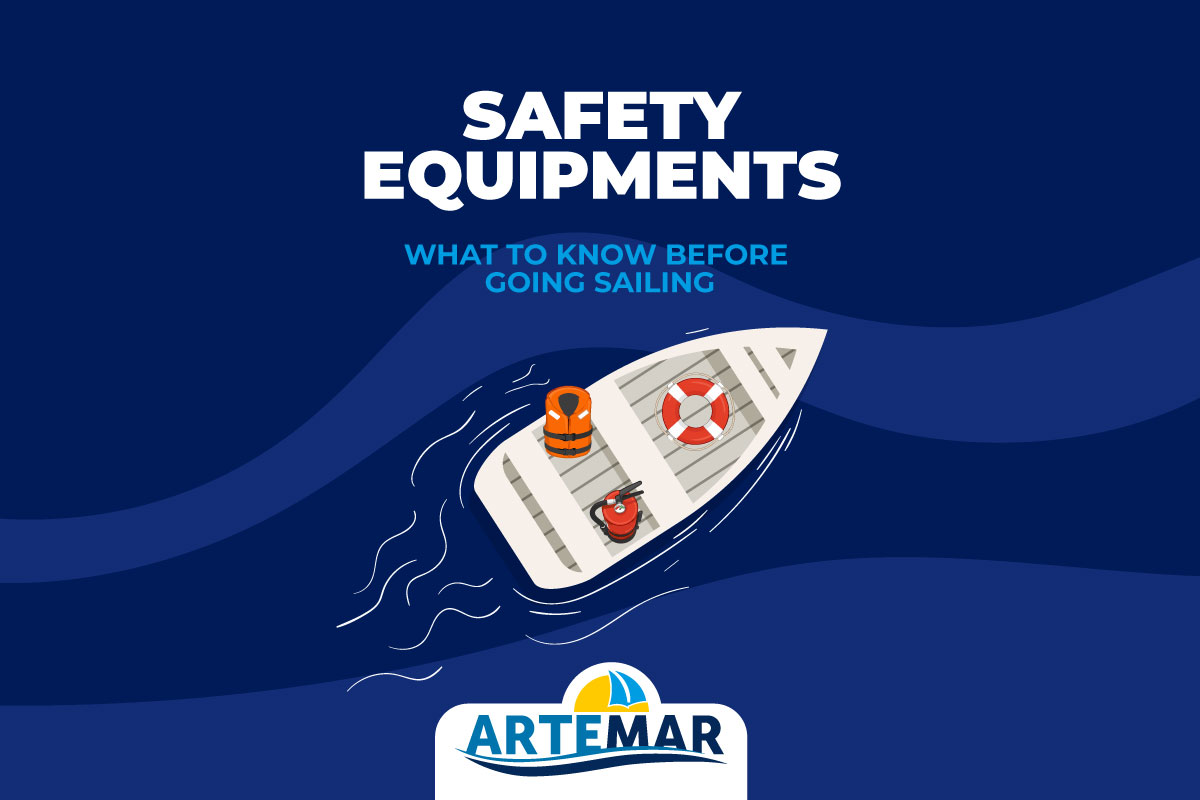
With the arrival of the warmer weather, the desire to return to sea, organize the first outings, and prepare the boat for the summer season increases.
However, we often focus on the engine, cleaning, batteries, or general maintenance, forgetting one fundamental aspect: on-board safety features.
Yet, that is precisely where all preparation should begin.
Because having the correct, functioning, and up-to-date equipment doesn’t just mean complying with regulations, but approaching every navigation with greater peace of mind and awareness.
The equipment changes according to the distance from the coast
One of the most important things to remember is that mandatory equipment varies based on distance from the coast.
Sailing within 3 miles, 6 miles, or 12 miles requires different equipment, both in quantity and type.
Many boaters tend to underestimate this difference, but during a check-up or in an emergency having a missing equipment can become a serious problem.
Within 3 miles: essentials
For navigation within 3 miles of the coast, some basic equipment is required:
• life belts for each person on board;
• annular life preserver with top;
• working fire extinguisher;
• red light hand fires;
• regulation lights;
• sound signaling devices.
Equipment that is often considered “basic”, but which must still always be carefully checked before each exit.
Within 6 miles: responsibilities and controls increase
A first visual inspection can already tell you a lot.
Check the shroud terminals at the base of the mast, look for signs of corrosion or deformation, and make sure the turnbuckles are not worn or seized.
Look at the mast from bow and stern: is it perfectly aligned? Do the tensions seem even?
If something doesn’t feel right, it’s time for a technical inspection.
The Artemar method: inspection, tuning, safety
When you increase the distance from the coast, the responsibilities on board also increase.
Additional emergency equipment becomes mandatory for navigation within 6 miles, including:
• smoke nozzles;
• red light parachute rockets;
• light wand;
• additional emergency reports.
In this range, the correct state of conservation and accessibility of equipment are also beginning to become fundamental.
It is not enough to have the equipment: it must be immediately usable.
Within 12 miles: safety becomes even more central
As you move further away from the coast, the level of preparation required changes completely.
For navigation within 12 miles, tools such as:
• coastal raft;
• VHF device;
• compass with deviation tables;
• complete emergency reporting equipment.
Under these conditions, security cannot be improvised.
Any check done before departure can make a difference while sailing.
Attention to deadlines
One of the most frequent errors concerns the validity of the equipment.
Hand fires, flares and smoke flasks have specific deadlines and cannot be used beyond the indicated deadline.
Even an uninspected fire extinguisher or a non-functioning headlight can create problems both during an inspection and, above all, in case of real need.
For this reason, it is important to carry out periodic checks and not wait until the start of the season to check everything at the last moment.
Security is not just an obligation
Many experience security equipment as a simple bureaucratic formality.
They are actually one of the most important aspects of navigation.
Being prepared means facing the sea with more serenity, protecting those on board and being able to manage any unexpected events with greater clarity.
Safety is not a detail: it is part of the sailing experience itself.
Get ready before you leave
The best advice is simple: check everything in advance.
Checking the condition of the equipment, checking the deadlines and making sure that each device is easily accessible allows you to start the season in the correct way.
If you have doubts about the mandatory equipment for your navigation or want to check that everything is in order, the Artemar team is available to help you.
